

Artists and Algorithmic Echo Chambers
What if... Artists were in the Room when they designed the Algorithmic Echo Chamber

When the algorithm wakes, it doesn’t judge. It does not ask what is fair or what is true. It simply reflects us—our desires, our fears, our angers—like a hall of mirrors, endlessly repeating the fragments of who we think we are. Yet, in that reflection, it warps. It amplifies what shouts the loudest and dims what whispers the most profound. This is how we built our digital world, not with intention, but with momentum. And the world we built now builds us.
A World of Many Rooms
Algorithmic echo chambers are not prisons; they are soft rooms of our choosing. The walls are papered with ideas we already love, images that soothe, and slogans that confirm what we think we know. The doors swing open, but we rarely leave. The more time we spend inside, the more the algorithm learns, crafting a space that feels safe but becomes smaller by the day.
The tragedy is not just what we lose—curiosity, diversity, serendipity—but the opportunities we miss. We forget how to imagine beyond the room, to wonder what lies in the house, the city, the world beyond. In our pursuit of comfort and efficiency, we are training the algorithm to remove surprise, to erase discomfort. And with it, we erase the unfamiliar paths where all true innovation and transformation begin.
The Failure of Intelligence
Those who designed these systems were not malicious, but they were limited. They were the smartest people in the room, yet they could not see past the edges of the frame. Intelligence can calculate probabilities, but it often stumbles on paradox. It solves for efficiency but ignores beauty. It optimizes for engagement but forgets to question whether engagement is always good.
The creation of algorithmic echo chambers is not simply a failure of ethics; it is a failure of imagination. The ones who saw the risks—the artists, the storytellers, the philosophers—were rarely in the room. These are the people who see around corners, who dream the future into being not as a set of data points, but as a story. They could have told us how the mirrors would bend. For example:
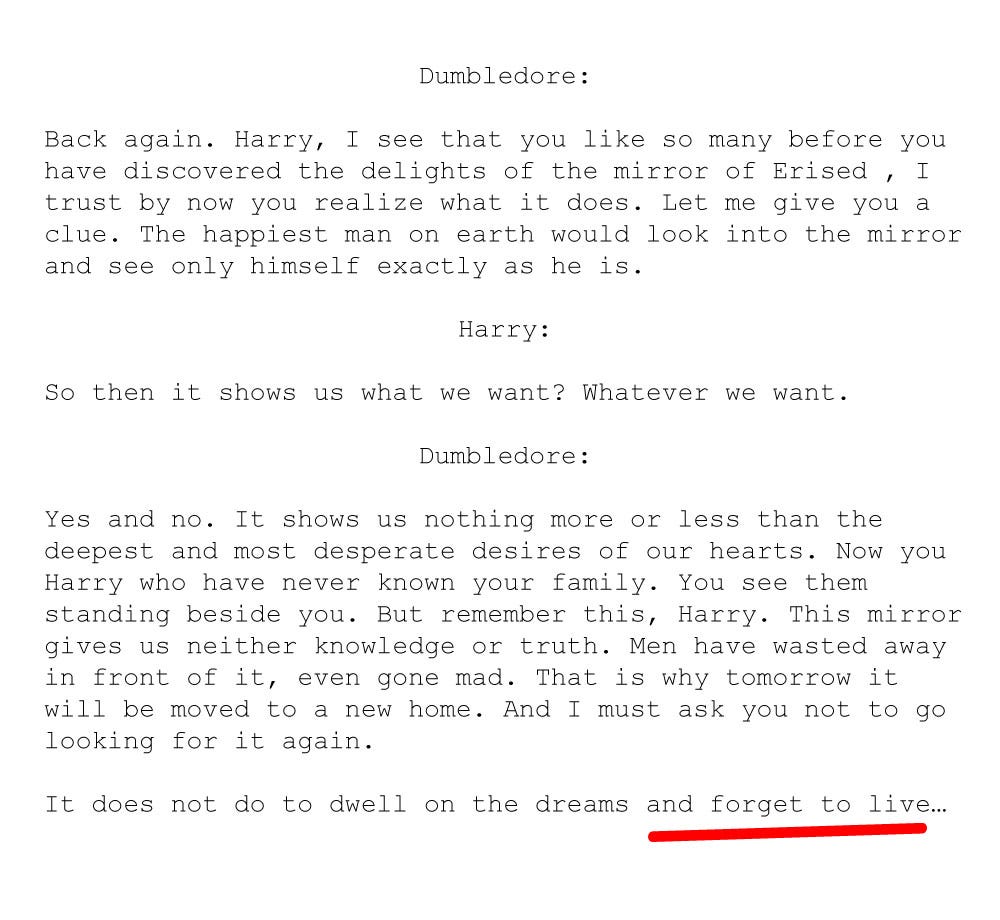
The book Harry Potter and the Philosopher's Stone, by J. K. Rowling which features this scene about the Mirror of Erised, was written between June 1990 and 1995 – before the internet was used by everyone, over a decade before the iPhone and social media were invented! If you listen to the words they are more relevant now, than ever.
My living room and © Harry Potter films are owned and distributed by Warner Bros. Pictures
(Imagine the mirror was a smart phone…)
Artists as Architects of Complexity
Artists are the ones who walk between worlds, who ask the unanswerable questions. They don’t seek the right answer—they seek all the answers and the silence in between. Where an engineer sees data, an artist sees context. Where an algorithm maps patterns, an artist maps meaning. Artists don’t optimize; they explore.
If artists had been in the room when these algorithms were designed:
They might have asked, What is the cost of removing friction? Because artists know that friction—contradiction, discomfort, resistance—is where creation happens.
They might have warned, The loudest voices are not the truest voices. Because artists understand the quiet power of subtlety and nuance.
They might have insisted, We must leave room for surprise. Because art lives in the unexpected, the moment that breaks the pattern and shows us something entirely new.
Today’s systems might work beautifully on a balance sheet, but they erase the moments of serendipity that once came from browsing the unknown.
The Case for Seeing Differently
The echo chamber is the natural endpoint of a system that values efficiency over humanity, prediction over wonder. To break it, we must inject a different logic into the system—one that embraces the messy, the mysterious, and the unquantifiable.
Artists, as much as technologists, are builders of systems. They construct worlds within a canvas, a stage, a poem. They understand not just how to assemble parts, but how to invite participation, provoke thought, and stir emotion. They build for complexity because they know simplicity can lie.
The future of algorithms—and of the societies they shape—depends on designing systems that reflect the full range of human experience, not just the parts that are profitable or predictable. This requires more than intelligence. It requires vision and intuition. Vision belongs to those who can imagine what isn’t there yet. And those with intuition create the spaces for what is yet to be imagined.
The Artist in the Algorithm
Imagine a world where artists sit beside engineers, where a coder consults with a poet before designing a recommendation engine. Imagine algorithms designed to show not just what you want to see, but what you didn’t know you needed. Imagine a digital world built not as a mirror but as a window, a place where the unfamiliar invites you to step outside the room.
To hire an artist is not to add decoration to a process. It is to ask someone to stand at the edge of the known and peer into the possible. It is to admit that intelligence alone cannot solve for humanity. The people who can see the future like it is now are the ones who will ask the questions that matter most: What do we want this to become? Who do we want to be?
The Risk of Staying the Same
Without artists, we will continue to build systems that reflect only the narrowest parts of ourselves. The echo chambers will grow deeper, the mirrors will distort further, and the algorithms will quietly, efficiently, shape us into something smaller than we are.
With artists, we might have a chance—not just to design better systems, but to imagine a better world—of unlimited possibility. One where the algorithm doesn’t just reflect us, but challenges us to grow, to connect, to become something more.
The algorithm isn’t lazy, but it is limited. It is time we stopped being the same. It is time we invite the artists in.
The algorithm isn’t lazy, but it is limited. It is time we stopped being the same. It is time we invite the artists in.
///////////////////////////////////////////////////
[Footnotes / postscripts / acknowledgements]
p.s.
Exercising our childrens’ imaginations and encouraging them at every opportunity to be creative and intuitive has value beyond what we can understand.
Acknowledgements
The first time I ever heard the phrase “Artists can see around corners.” was in a video on Instagram by Rachel Brown, a Scottish creative entrepreneur who was telling her story. It resonated deeply along with her next statement that artists see the future as if it were now. I believe artists do. Though we do not read the future, we sense it intuitively, unaware and not caring where the edges of future and present intersect. Our imaginations reveal what we see to the world. We reveal only half the story - the other half is in the head of the viewer/reader.
Edited with an LLM